
When a Raise Comes at a Cost: Understanding the Benefits Cliff
What happens when a 50-cent raise costs a family hundreds of dollars in food assistance.
It's not a rare story — it's happening to nearly 25 million people in this country right now.
That's what Feeding America's latest Map the Meal Gap report found: nearly half of everyone experiencing food insecurity has an income too high to qualify for SNAP — the federal program that helps families keep groceries in the fridge when the paycheck doesn't stretch far enough.
Not because they're necessarily doing well.
Because the line between qualifying for help and earning "too much" can be remarkably thin.And that's a tension I think those of us working in this space need to talk about more.
We refer neighbors to job training. GED programs. Career opportunities. We celebrate when someone finishes a program, finds a better job, or earns a well-deserved $1, $2, or $3 more an hour.
We should celebrate those things.
But what if that raise also means losing food assistance, childcare support, or another benefit their family depends on? A step forward on paper can become a step backward at the kitchen table. There's a name for this: the benefits cliff.
That worries me.
At The Store, we absolutely believe supportive services are an important part of addressing the root causes of food insecurity. We work alongside more than 70 nonprofit partners to connect neighbors with resources that can help create greater stability.
Ultimately stability is the goal, not simply a higher hourly wage. But I don't think the two have to be in conflict.
I don't pretend to have the policy answer here. I do think those of us helping families move toward greater economic security have a responsibility to understand the whole picture and the unintended consequences that come with the benefit cliff.
I keep coming back to this: progress shouldn't mean having less food in the refrigerator. A raise should feel like a raise.
A higher wage should bring greater stability - not less food on the table. But for millions of families, even a small raise can mean losing critical assistance. The Store explores the “benefits cliff” and why true progress must consider the full picture of financial security.
More from The Store
Standing in the Gap: The People Behind The Store Experience
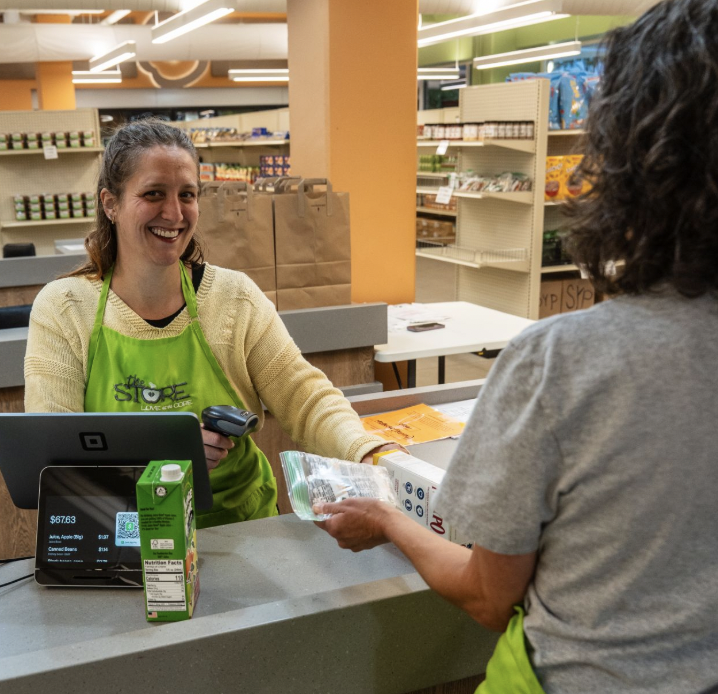
When summer volunteer shortages stretched The Store’s team, staff and volunteers stepped in wherever they were needed. The result? Our customers didn’t notice a difference—a powerful reflection of the people committed to making dignity, choice, and care non-negotiable.
Read More.JPG)
Building the Next Generation of Leaders at The Store
Applications are open for The Store’s Young Professionals Board, a two-year opportunity for emerging leaders to serve their community, take on meaningful responsibility, and help advance our mission of providing groceries with dignity and choice.
Read More